this is my debut album, which I completed in 2023.
I made it for the final project of my music degree, and It was my first real excuse to draw together threads from all that I had studied, as well as my independent learning and practice in production from before my course.

In Italo Calvino’s book Invisible Cities, Marco Polo recounts stories of cities that he has come across on his travels, in a stream of poetic and often fantastical page-long descriptions. It eventually becomes clear that all of these descriptions are of the same city – Venice. Calvino’s Venice could only be described through the medium of over a hundred, often irreconcilable, descriptions of other cities, because any attempt to distill Venice into one description would be reductive, or be rendered incorrect by the time it came to be written down.
The idea resonated with me. I felt, at the time, emotionally changeable, and knew that any one feeling that could inspire music would quickly become outdated and false over the time taken to extract an album from it. Instead, I decided to capture fleeting thoughts over the months remaining of my deadline in whichever sonic form felt the most honest at the time, and collect them together afterwards, trusting them to reveal a form when thrown into contrast. Ideally, whichever underlying emotional processes were underway would reveal themselves, taking the place of Calvino’s Venice.
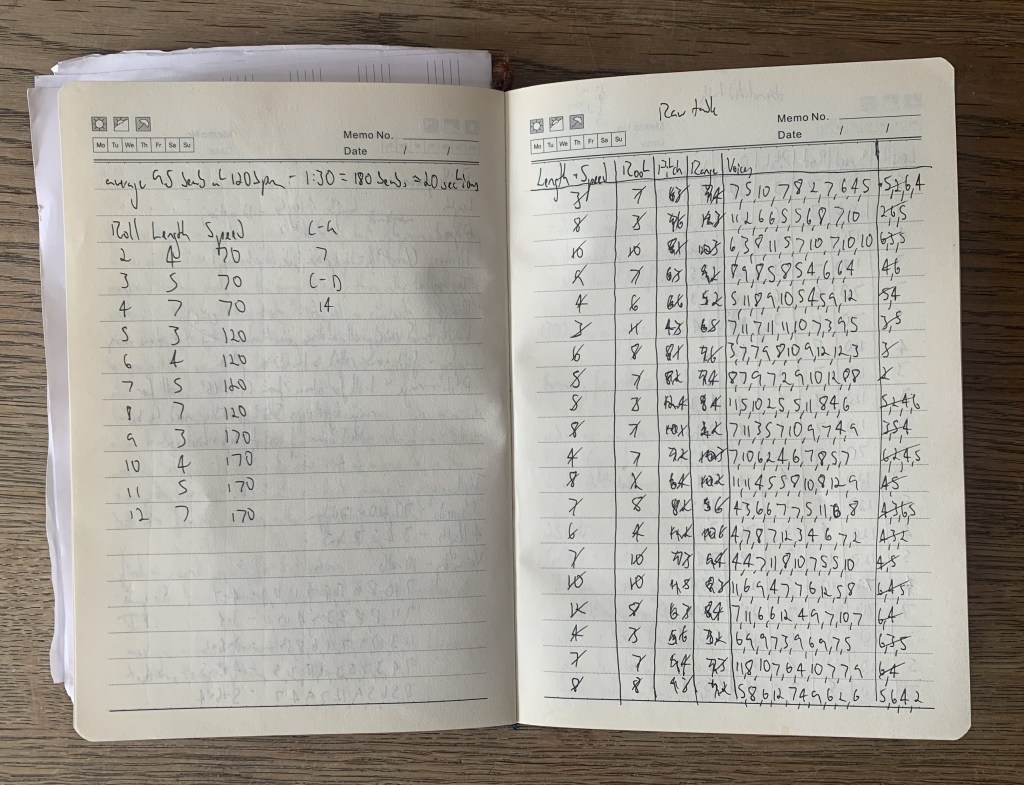
Compositional processes changed throughout the album, then, to allow for this honesty. The first section of ‘Loving the Wind,’ was performed live with a MIDI controller, as the mindfulness of listening to and performing ambient-adjacent music was an important feeling in my life at the time. By contrast, the audio sampled on ‘Cracking the Glass,’ came from an experiment with no-input mixing when the catharsis of harsh digital noise felt more appropriate. Fitting these different styles into a cohesive album came surprisingly naturally – organising sections of tension and release, and focussing on the transitions between tracks, they came to fall into a narrative of pulling order from disorder and sense from chaos, which seemed to reflect the process of working on the album itself.
The album acted as a diary for me through the turbulent last few months of a degree, and after, as I kept working with it, displaying it at the grad show at the Edinburgh College of Art and adapting it for live performances. The technical challenges of producing and then mastering a diverse electronic album pushed me, and so it stands to reflect the range of my production abilities. The creation process inspired me in the projects I then moved on to, particularly the score to the short animated film ‘Chaos’.
As this wave from memories flows in, the city soaks it up like a sponge and expands. A description of Zaira as it is today should contain all Zaira’s past. The city, however, does not tell its past, but contains it like the lines of a hand, written in the corners of the streets, the gratings of the windows, the banisters of the steps, the antennae of the lightning rods, the poles of the flags, every segment marked in turn with scratches, indentations, scrolls.
an extract from ‘Zaira’, from Invisible cities. this extract always felt particularly important to the album, and directly inspired the last track.
 olly flaig